
As the cost of college continually rises, and oftentimes outpaces the rate of inflation, many average, every day families are wondering, “How do people afford college?” Although winning a huge scholarship to cover the full cost of college is ideal, it’s not the reality.
Fortunately, there are more realistic ways to pay for college.
 You can also search for scholarships and grants with sites like Fastweb. We host nationwide, institution, and local scholarships within our database. All you have to do is fill out a profile on our site, and we’ll match you to scholarship opportunities that you qualify for.
The FAFSA becomes available on October 1, and you’re encouraged to complete this form as soon as possible. Many states and schools distribute financial aid on a first-come, first-serve basis.
Financial aid packages will typically include multiple forms of aid. Grants do not have to be paid back. Work study allows you to work a student job on campus, and your paychecks can be used to pay for tuition or other expenses, like meals off campus, books, etc.
Finally, federal student loans may be part of a financial aid package. This is money that is lent to you in order to cover your college costs, and it must be paid back after graduation. If you do need student loans to cover the cost of attending college, federal loans are the best because they have lower interest rates than private student loans.
You can also search for scholarships and grants with sites like Fastweb. We host nationwide, institution, and local scholarships within our database. All you have to do is fill out a profile on our site, and we’ll match you to scholarship opportunities that you qualify for.
The FAFSA becomes available on October 1, and you’re encouraged to complete this form as soon as possible. Many states and schools distribute financial aid on a first-come, first-serve basis.
Financial aid packages will typically include multiple forms of aid. Grants do not have to be paid back. Work study allows you to work a student job on campus, and your paychecks can be used to pay for tuition or other expenses, like meals off campus, books, etc.
Finally, federal student loans may be part of a financial aid package. This is money that is lent to you in order to cover your college costs, and it must be paid back after graduation. If you do need student loans to cover the cost of attending college, federal loans are the best because they have lower interest rates than private student loans.
How the Average Family Pays for College
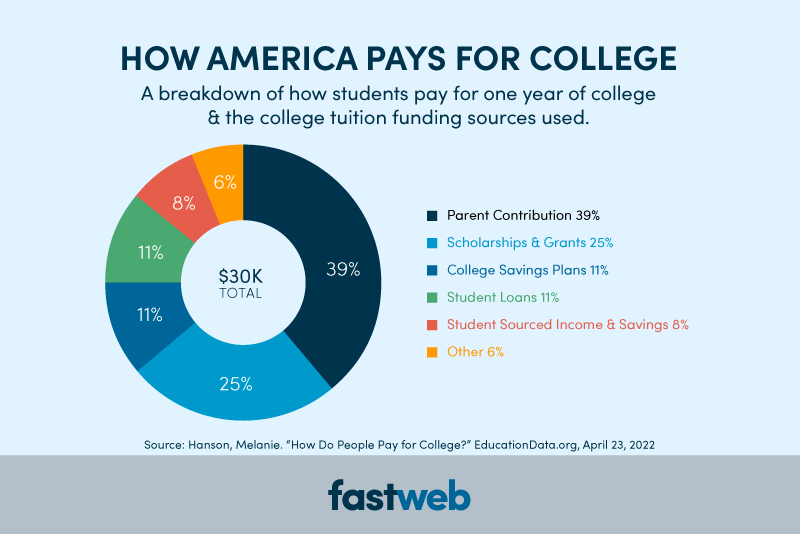
The average family likely doesn’t have a huge college savings account that will cover the full cost of tuition. It may cover a year or two, but in addition to saving for college, the average family has been paying a mortgage or rent, bills, and saving for retirement. As families make a plan to pay for college, they need to strategize. This means that they can’t rely heavily on one resource. Rather, how America pays for college is by looking at a variety of tuition funding sources.College Tuition Funding Sources
The average family uses a few – or all – of the following to pay for college:- Scholarships and Grants – Free money that does not have to be paid back.
- Financial Aid – Distributed by the government and/or colleges and comes in the form of grants, work study, or student loans.
- Private Student Loans – Money that you have to pay back after graduation.
- College Savings – Any money saved before or while the student is enrolled in college.
- Part-Time Jobs and Internships – Money received from paychecks can help cover tuition costs.
- Education Tax Benefits – Credits received for being enrolled in college.
College Scholarships and Grants
Scholarships and grants are free money that help to pay for college, and these never have to be paid back. You can qualify for scholarships and grants simply by applying to college. Many colleges and universities will offer merit aid when they send you an acceptance letter. You do not need to fill out separate applications for merit scholarships or grants. Rather, the amount is determined by the information you provide on your college application, like GPA, test scores, and extracurricular involvement.College Financial Aid
Financial aid is defined as grants, work study, and federal student loans. You must qualify for financial aid in order to receive it, and this is done by completing the Free Application for Federal Student Aid (FAFSA).Private Student Loans
Oftentimes, there is a gap between scholarships and financial aid and what the college costs. In order to bridge this gap, many students take out private student loans. Private student loans should be used as a last resort so that you don’t have to borrow too much for your education. When it is time to borrow, you can look at loan providers through Fastweb or ask your financial aid office for their preferred lender list. This is a list of lenders that they have worked with in the past.College Savings
Although financial experts will urge you to start saving for college as soon as your children are born, you can really start saving at any time. Even if you only manage to save a few hundred dollars before school starts, a dollar saved is a dollar less that students will have to borrow. Parents of college-bound students can open a 529 savings plan. This type of savings account offers tax and financial aid benefits, making it the safest way to save money for college. However, there is one caveat: The 529 savings plan should be in the parents’ names and not the student’s. When it comes time to fill out the FAFSA, a student’s assets are scrutinized more heavily than parent assets. A 529 savings plan could count against a student, whereas that wouldn’t be the case if it’s counted as a parent asset.Part-Time Jobs and Paid Internships
Many students opt to work a part-time job or use money from a paid internship to cover college costs, like tuition or student expenses. While scholarships and financial aid have to go to designated costs, money from your jobs can be used for anything. Furthermore, some employers have begun offering their part-time employees tuition assistance. Though there are stipulations as to where you can use the tuition assistance, many have expanded their networks to include local and nationally known colleges and universities. Walmart, Chipotle, and UPS are just a few of the companies offering employee tuition assistance.Education Tax Credits
There are tax credits you can claim each year simply for being enrolled in college:- Lifetime Learning Tax Credit – Up to $2,000 per year can be claimed for being enrolled in any continuing education courses or programs. This ranges from PhD programs to career development courses.
- American Opportunity Tax Credit – Up to $2,500 can be claimed for up to four years by students seeking a degree, certification, or other recognized credential.